Knowing how to create a customer journey is one of the most practical things a CX or marketing team can do. It turns scattered assumptions about customer behavior into a structured, shared view of what actually happens when someone interacts with your brand.
The customer journey covers every interaction a customer has with your business, from the first time they hear about you to the moment they become a loyal advocate or a churned account. When you map it clearly, you can see exactly where the experience is working and where it is breaking down.
This guide walks through six steps to build one that reflects real customer behavior and connects to measurable business outcomes.
What is a customer journey?
A customer journey is the complete sequence of interactions a customer has with a brand, from initial awareness through purchase, use, and beyond.
It is not a straight line. Most customers move through multiple channels, revisit earlier stages, and interact with a brand in ways companies do not always anticipate. The journey map is a tool for making that complexity visible and actionable.
Understanding the customer journey is foundational to customer experience management. Once you can see the full path, you can identify where customers drop off, where expectations are not being met, and where small improvements create the biggest gains in retention and satisfaction.
Why building a customer journey matters
Without a documented customer journey, different teams operate on different assumptions about who the customer is and what they experience. Marketing, sales, support, and product all see different slices of the customer relationship. The journey map brings those slices together.
The business case is clear. According to McKinsey, companies that excel at customer journey management see revenue increases of 10 to 15% and cost reductions of 15 to 20% compared to those that focus only on individual touchpoint optimization.
For US organizations managing complex, multi-channel customer relationships, the journey map is also a diagnostic tool. It reveals which touchpoints are creating friction, which stages have the highest drop-off rates, and which customer segments experience the journey differently from others.
How to create an effective customer journey step by step
These six steps take you from raw customer data to a usable journey map with clear actions attached to each stage.
Step 1: Build your customer profile
Every customer journey starts with knowing who you are mapping for.
A buyer persona is a research-based profile that represents a segment of your customer base. It includes demographic information, goals, pain points, preferred channels, and typical behaviors. One persona is rarely enough. Most organizations need two to four to represent meaningfully different customer segments.
How to build one:
- Run customer satisfaction surveys to capture what customers value and where they struggle
- Conduct qualitative interviews with current and churned customers
- Pull behavioral data from your CRM, website analytics, and support tickets
- Look for patterns in Net Promoter Score data to understand what drives loyalty vs detraction
The goal is a profile grounded in real data, not internal assumptions about who the customer is.
Step 2: Define the stages and set goals for each
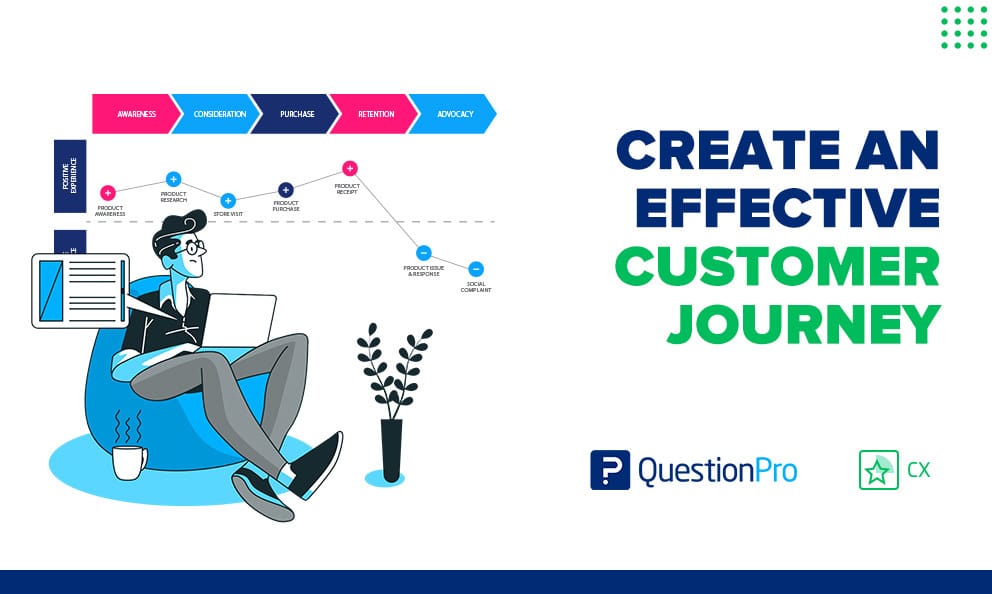
The customer journey typically moves through five stages: Awareness, Consideration, Purchase, Retention, and Advocacy.
Not every customer goes through them in a straight line. Many cycle back, skip stages, or take multi-channel paths. But having clear stage definitions gives your team a shared framework for mapping behavior.
For each stage, define:
- What the customer is trying to accomplish
- What questions they are asking at this point
- What a successful outcome looks like from the customer’s perspective
- What metric you will use to measure success at this stage
Setting stage-level goals prevents the journey map from becoming a documentation exercise. It connects each stage to a business outcome you can actually track.
Step 3: Map all customer touchpoints
A customer touchpoint is any moment where a customer interacts with your brand, across any channel, at any stage of the journey.
This includes:
- Paid and organic search results
- Social media posts and ads
- Website pages and product listings
- Sales calls and demos
- Onboarding emails and in-app experiences
- Customer support interactions
- Review sites and community forums
- Renewal and re-engagement communications
The objective is completeness. List every touchpoint you know about, then audit your data to find ones you may have missed. Support tickets, chat logs, and session recordings often reveal interactions that do not show up in your planned channel list.
Not all touchpoints carry equal weight. Some have an outsized impact on whether customers move forward or drop off. Identifying those high-impact moments is what makes the mapping exercise valuable rather than just comprehensive.
Step 4: Identify pain points at each touchpoint
Pain points are the moments where the customer experience fails to meet expectations.
They show up as:
- High drop-off rates at specific pages or stages
- Repeated support contacts about the same issue
- Low satisfaction scores tied to particular interactions
- Qualitative feedback describing confusion, friction, or frustration
Every touchpoint is a potential pain point if not carefully managed. The goal is not to eliminate every imperfection but to prioritize the pain points that have the highest impact on conversion, retention, or satisfaction.
Map the pain points alongside the touchpoints so you can see the pattern clearly. Where are customers consistently struggling? Are the pain points concentrated in one stage or spread across the journey? That pattern tells you where to focus improvement efforts first.
Step 5: Choose your journey map type
There are four main types of customer journey maps. The right one depends on what you are trying to accomplish.
| Map type | What it shows | Best used for |
|---|---|---|
| Current state | How customers interact with your brand today | Identifying gaps and improving existing experience |
| Everyday life | What customers experience daily, beyond your brand | Uncovering unmet needs and new opportunities |
| Future state | How you want the customer experience to work | Planning new products, services, or processes |
| Service blueprint | The full view connecting customer journey to internal operations | Aligning teams and identifying operational barriers |
Most teams start with the current state map. It is the most grounded in real data and produces the most immediately actionable insights. Future state and service blueprint maps come later, once you have a clear picture of where you are today.
Step 6: Define actions and measure outcomes
The final step is where the journey map becomes useful.
For each pain point and gap identified, define a specific action:
- Who owns the fix
- What the change involves
- The timeline for implementation
- The metric that will tell you whether it worked
Without this step, a journey map is an interesting document that sits in a folder. With it, the map becomes a working tool that drives real improvement in the customer experience.
Track the metrics tied to each stage goal over time. Are drop-off rates at the consideration stage improving? Are support contacts related to a specific pain point decreasing? Are satisfaction scores rising at the touchpoints where you made changes? Those trends tell you whether the map is working.
Common mistakes when creating a customer journey
Most journey mapping efforts fail for predictable reasons.
- Building it from internal assumptions. The map should reflect what customers actually experience, not what teams assume they experience. Without customer data, it becomes an exercise in documenting wishful thinking.
- Only mapping the happy path. Most customers do not take the ideal route. A journey map that only shows the smooth path misses the friction points where real customers actually struggle.
- Not connecting stages to metrics. A journey map without measurable goals per stage cannot be evaluated or improved over time.
- Treating it as a one-time exercise. Customer behavior changes. Markets shift. New channels emerge. The journey map should be reviewed and updated at least annually, or whenever a significant change affects the customer experience.
- Keeping it inside one team. A journey map that only lives in the marketing or CX team has limited impact. The most effective journey maps are shared across departments and used to align cross-functional decisions.
How QuestionPro CX supports customer journey mapping
Mapping the customer journey requires feedback data from multiple stages and channels. QuestionPro Customer Experience provides tools for collecting that data through surveys at specific touchpoints, NPS programs tied to journey stages, and real-time dashboards that surface experience trends across the customer lifecycle.
For teams building or refining a customer journey map, the ability to collect structured feedback at onboarding, post-purchase, support interactions, and renewal touchpoints creates the data foundation the mapping process needs. The analytics layer helps connect survey results to specific journey stages rather than treating customer feedback as an undifferentiated stream.
A customer journey map is only as good as what you do with it
The six steps in this guide produce a map. What produces results is what happens after the map is built.
The organizations that get the most value from customer journey mapping are the ones that use it as a living tool, revisit it regularly, connect it to real metrics, and build cross-functional accountability around the gaps it reveals.
For US businesses managing increasingly complex, multi-channel customer relationships, the journey map is one of the clearest ways to move from reactive customer service to proactive experience design. It does not require expensive technology to start. It requires honesty about what customers actually experience and discipline about acting on what you find.
Frequently Asked Questions (FAQs)
The first step is building a research-based customer profile, or buyer persona, that represents a real segment of your customer base. Without a clear picture of who you are mapping for, the journey map reflects internal assumptions rather than actual customer behavior and needs.
Most businesses need more than one. Different customer segments, product lines, or acquisition channels often produce meaningfully different journeys. Start with the most common customer path, then build additional maps for segments with significantly different behaviors or needs.
Useful data sources include customer surveys, NPS and CSAT scores, CRM records, website and app analytics, support ticket logs, sales call recordings, and qualitative interviews with current and former customers. The more data sources you combine, the more accurate the map.
At minimum, review and update the map annually. Also update it when a significant change affects the customer experience, such as a product launch, a new channel, a pricing change, or a shift in customer feedback patterns. A static map quickly becomes inaccurate.
The customer journey is the actual sequence of interactions a customer has with your brand. The customer journey map is a visual or structured document that represents that journey, making it visible, shareable, and actionable for teams across the organization.